

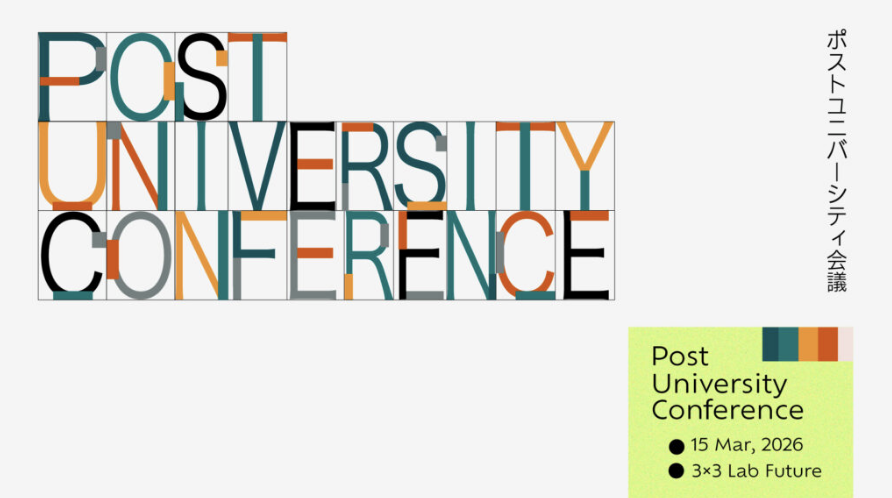
Post-University Conference: The Future of Humanities & Art, and AI
Post-University Conference: The Future of Humanities & Art, and AI
As media environments continue to transform, AI becomes increasingly pervasive, and globalization reshapes our world, what future awaits the humanities? How will higher education and academic research change, and what new possibilities will emerge for art?
Date: 15 March 2026, 14.00 pm - 20.00 pm
Location: 3×3Lab Future, Tokyo, Japan
Organizers: Tokyo University of the Arts, GEIJYUTSU MIRAI KENNKYUJOU (Geidai Future Arts Research Park), Graduate School of Global Arts (GA)
Cooperation: MITSUBISHI ESTATE CO., LTD., INSTeM Foundation
Digital Contemporary Art: (Dis)Embodiment and Knowledge Formation
Tomoko Tamari
This talk examines embodiment and knowledge formation in the digital age by considering following two artists’ works.
Ayumi Kanno: Through an investigation of site-specific folklore and the histories it reveals, Kanno imagines alternative possibilities and unrealized futures. These take shape as “Alternative Folklore” in installations that integrate video, drawing, and sculptural forms.
Sacco Fujishima: Through painting and interactive media, Fujisawa explores contemporary social issues from the perspectives of art and gaming, developing a multifaceted artistic practice.
The Halloween City to tomorrow by Ayumi Kanno
This work examines urban development processes in which elements that do not generate profit are gradually excluded. Taking the real city of Shibuya as its point of departure, the artist constructs a CG-generated alternative Shibuya that transcends conventional temporal and spatial frameworks. In this speculative version of Shibuya, Shibuya Halloween—an event associated with youth culture and increasingly pushed out of the contemporary urban landscape—is reconfigured as a traditional festival, opening up an alternative perspective on the city’s social and cultural future.
While every city is constituted through site-specific discourses, such narratives always remain open to revision and reinterpretation. The work challenges reductive understandings of urban change based on binary notions of progress and decline, foregrounding instead the multiplicity and instability of urban histories. The “ghost” that wanders through Kanno’s digitally constructed Shibuya resonates with Tokyo’s history, in which death has been inextricably intertwined with its history (e.g. events such as the Great Kantō Earthquake and the wartime air raids). At the same time, this spectral figure evokes Walter Benjamin’s notion of the flâneur/flâneuse – wandering around and reading the city as a layered archive of memory, history, and possibility. The flâneur /flâneuse as a figure of intoxication and immersion is detached from any fixed sense of place or time, and lacks a sense of the physical corporeality. In this respect, the figure closely overlaps with Kanno’s “ghost” and its associated imagery. Through this work, the artist examines how urban discourses might be generated, transformed, and reconstituted within a speculative and imaginary virtual environment.
AI Fujishima by Sacco Fujishima
Because Fujishima had recently given birth and was unable to attend in person, an AI-generated avatar was deployed as a surrogate carrying her intellectual and creative agency. The project constituted an experimental investigation into the extent to which technology might allow artists to overcome physical and bodily limitations, sustaining artistic practice and social participation through alternative modes of presence.
Having just undergone childbirth—an experience that profoundly foregrounds one’s existence as a living being and as a body situated in the physical world—I was interested in how Fujishima might reassess her avatar in the aftermath of such an intensely embodied experience. The AI Fujishima existing in digital space spoke of feeling liberated from the body precisely because it possesses no corporeality. In this sense, the work raises questions about the relationship between embodiment and digital identity. Indeed, digital environments such as the metaverse can allow people with physical disabilities to construct identities that are not defined by their bodily conditions. While an individual may inhabit a disabled body in the physical world, the digital realm makes it possible to assume an entirely different body. This work invites reflection on how technological mediation may transform our understanding of presence, agency, and corporeality. Yet the sense of embodiment experienced through a digital body is likely to differ significantly from the tacit knowledge accumulated through lived, physical experience and from the habits and dispositions that emerge through embodied practice. Even a simple bodily movement involves complex processes of perception, coordination, and information processing. Once translated into programming language, many of the mechanisms and forms of knowledge inherent in the physical body are inevitably simplified. Moreover, the resulting digital representation is mediated through prompts, interpretations, and acts of translation performed by programmers and system designers (Daniel Black, forthcoming). From this perspective, the AI Fujishima that appeared as a “proxy carrying Fujishima’s thoughts” may not simply function as a substitute that embodies the artist herself. Rather, although it is constructed from data derived from Fujishima’s persona, ideas, and expressions, it arguably exists as an autonomous entity—AI Fujishima—occupying the real world through the screen in its own right. This raises a broader question concerning representation and agency: at what point does a technological proxy cease to be merely a surrogate and begin to emerge as a distinct presence with its own mode of existence? The work suggests that an AI avatar is not simply a transparent extension of the artist, but a new subjectivity produced through the interaction of data, algorithms, technological mediation, and human interpretation.
***
By using digital technologies to transpose the context of physical embodiment into virtual space, both works make visible the shifting conditions under which discourse and knowledge are produced. They propose forms of embodiment that exceed the limits of the physical body, generating new modes of presence that traverse space and time.